Tuesday, February 24, 2015

Reclaiming the Love of Learning

sad student

Reclaiming the Love for Learning
 
Children are vulnerable. In an optimal environment, they are not expected to experience this vulnerability until later in life when their minds and nervous systems are equipped to handle elevated levels of fear, stress, and overwhelm. Yet, the key phrase here is "optimal environment." Unfortunately, we live in the "real" world, so children will often find themselves in situations that are far from the optimal and the result can be childhood trauma.

Childhood trauma happens at both the emotional and psychological level and it can have a negative impact on the child's developmental process. During a traumatic event (abuse, neglect, adoption, accidents, birth trauma, etc.), the lifelong impact is even greater if the child believes he powerless, helpless, and hopeless. When a child experiences one or all of these feelings, he begins to believe the world is dangerous. Repeated experiences of these feelings will create a lasting imprint from which he operates and behaves. A framework based in fear and survival becomes the child's viewpoint of the world around him.
These early life experiences then influence the child's ability to "behave," or more correctly expressed, the child's ability to stay "regulated." Trauma impacts a child's ability to stay calm, balanced, and oriented. Instead, children with traumatic histories often find themselves in a "dysregulated" state, which manifests into a child who does not behave, cannot focus, and/or lacks motivation. It is not a matter of choice or a matter of "good" child verses "bad" child; it is simply an imprint from the child's past history. It's the child's new normal.

When working with children like this in the classroom, the most effective way to work with them is to work at the level of regulation, relationship, and emotional safety instead of at the level of behavior. These children's issues are not behavioral; they are regulatory. Working at the level of regulation, relationship, and emotional safety addresses more deeply critical forces within these children that go far beyond the exchanges of language, choices, stars, and sticker charts.

Traditional disciplinary techniques focus on altering the left hemisphere through language, logic, and cognitive thinking. These approaches are ineffective because the regulatory system is altered more effectively through a different part of the brain known as the limbic system. The limbic system operates at the emotional level, not at the logical level. Therefore, we must work to regulate these children at the level of the limbic system, which happens most easily through the context of human connection.

When the teacher says to a non-traumatized child, "Andy, can you please settle down and quietly have a seat?" Andy has the internal regulatory ability to respond appropriately to his teacher because trauma has not interrupted his developmental maturation of developing self-regulation tools and feeling like he is safe in the world. However, when Billy (the traumatized child) is asked the same question, his response is much different. He takes the long way around the classroom to his seat, he continues to not only talk but projects his voice across the room as if he is still out in the playground, and once seated continues to squirm and wiggle.

Traditionally, we have interpreted Billy as a disruptive child, pasted the label ADHD (attention deficit hyperactivity disorder) onto him, and reprimanded him for his "naughty" behavior. What we have failed to see is that Billy cannot settle down on his own. His internal system has not experienced the appropriate patterning to know how to be well behaved like his classmate Andy and Billy does not know he is safe in this world, even if he is now in a safe environment.

The brain-body system is a pattern-matching machine. A child with little internal self-control will pattern himself according to his past external experiences. If his past experiences have been chaotic, disruptive, and overwhelming (trauma), he will continue acting this way until new patterns are established. Thus, a child coming into a calm and safe classroom is still likely to be acting as if he is in his previous chaotic and unsafe environment. A child can be taken out of trauma but not so easily can the trauma be taken out of the child. Past patterns of chaos are now the current framework for navigating his world; he knows no different.

The most effective way to change these patterns comes through safe, nurturing, attuned, and strong human connection. For the student in the classroom, it comes through the teacher-student relationship. The reality is, for our traumatized children to learn and achieve academically, science is showing that they must be engaged at the relational level prior to any academic learning.

Press on,


Facebook Twitter Pintrest YouTube Google Plus

Heather T. Forbes, LCSW
Parent and Author of Beyond Consequences, Logic & Control: Volume 1 & Volume 2,
Dare to Love
, and Help for Billy.

Tuesday, February 17, 2015

When Siblings Become Traumatized


 Sisters

Q: For the past three years, our 16-year-old daughter, Jackie, has had to deal with the complete chaos of her younger adopted sister who was severely traumatized before we adopted her. Jackie was an only child before my husband and I adopted and my world revolved around Jackie. We lived a relatively peaceful, fun, and happy life. All of that drastically changed once her sister entered our family. I realize now that Jackie has been traumatized by the disruption, fear, and struggles our family has endured. What can I do to help my daughter, without dismissing the trauma she has gone through?

A: You're exactly right when your say Jackie's trauma of living with a severely traumatized younger sister cannot be dismissed. In fact, her experience needs to be maximized and brought to the surface in order for her to find healing. Jackie needs the emotional space to be heard and to be understood.

However, listening to your daughter's challenges can easily evoke feelings of guilt, shame, and perhaps, resentment in you. When this happens, all too often, parents inadvertently stop listening and work to minimize or stop their child's pain, closing off this child's needed opportunity to have a voice.

The first place to start is to realize that you cannot fix Jackie's experiences from the past three years. What is, is. Yet, what you can do is work to understand her experiences (getting into her shoes) and giving her the time, patience, and emotional space to discharge ALL of her feelings.

It takes being willing to commiserate with her and allowing her to express her story, not just at the cognitive level, but at the emotional level. Absorbing her pain means not responding in a defensive or a minimizing manner and not giving her solutions for the moment (that can come later).

A conversation might sound something like this:

Mom: "Sweetheart, there is something that I haven't recognized about your life. I haven't seen how difficult it has been for you since your sister came home. For the last three years, especially when she came home, I probably ignored you sometimes, I didn't pay the same amount of attention to you, and I wasn't there for you."

Jackie: "You just care for her more than you do for me!"

Mom: "Is that what it feels like?"

Jackie: "Yes! She gets ALL the attention. You sleep with her, you cater to her every need, and you spend all your time with her."

Mom: "I do. And where does that leave you?"

Jackie: "With NOTHING! Everything I ever had is gone. I'm MAD. I'm so tired of her. I'm tired of her meltdowns. I want it to go back to the way it was before she was here. I don't want it to be this way."

Mom: "I hear you, honey. Tell me more. Tell me how hard this has been for you because I've expected you to be the grown up in this. Tell me how that's not fair to you."

Jackie: "It isn't fair. She embarrasses me. She can't do anything. WE can't do anything and our whole life is centered around everything that SHE ever does. We can't do anything we used to do. Everything is different. I just want it to go back; I just want it to go back to the way it was before."

Mom: "I know....." (quietly pausing and working to stay present with her daughter)

Jackie: "I'm angry."

Mom: "Are you angry at me and dad for doing this? Tell me. I can handle your anger. I want you to give it all out to me. I haven't known how angry you are at me...I'm okay with it. Tell me 'I'm mad at you, mom!'"

Jackie: "I'm AM mad at you! I'm mad at everything. I hate that you and dad did this to me. Why didn't you love me enough not to mess up my entire life??!!?"

This conversation might need to continue for a while, each time with mom "dancing" with whatever her daughter says in return, allowing her daughter to lead the conversation. Yet, the most important part of such a dialogue is that it happens with emotional intensity, at the heart level.

Allowing Jackie the safety of a parent who is present and working to just listen, will allow her to discharge her anger, pain, and frustration now and not in the heat of a difficult moment when her sister is melting down.

But perhaps you are saying that you've tried this and these types of conversations happen over and over without movement forward.

If this is the case, then you have to dig deeper. Are you stopping your daughter at any level? Are you really able to handle her anger and pain? What feelings inside of you are coming up when she is expressing? Guilt? Fear of the future? Helplessness?

Feeling the depth of your child's pain in these moments, coupled with your own dark feelings that have not been honored or expressed, will shut you down. Your daughter will feel this. Thus, her expression is not being heard and she stays stuck in her healing process. When this is the case, conversations like the one above will keep looping and looping, keeping everyone in a state of victimhood.

You have to allow your pain to be felt, honored, and understood. In order for you to feel your child's pain, you have to feel your own pain first. This can be scary. It may seem that if you feel the depth of pain within you, opening up the floodgates, you won't be able to parent effectively and you won't be able to pull it together.

Ironically, this is exactly what keeps parents from being able to parent the way their children need them to. Parents have to go deep within the caverns of their own hearts. They have to own and acknowledge their own pain.

Parents have to stay in their hearts; that is where their children are living.

Effective parenting ultimately comes from self-love, self-discovery, and self-understanding. Love yourself through your pain in order to get to the depth of your child's pain. Healing resides within this powerful dynamic.

And remember, it isn't always about "fixing" the situation with your child. The "fixing" comes from listening, giving your child a voice, and simply being present.

Press on,


Heather T. Forbes, LCSW
Parent and Author of Beyond Consequences, Logic & Control: Volume 1 & Volume 2,
Dare to Love
, and Help for Billy.

Tuesday, February 10, 2015

Compassion Leads to Happiness


Mom & Daughters Q: I have two children who have been a constant struggle for the past 8 years. Each suffered emotional and physical abuse, as well as neglect for the first 3 or 4 years of their lives. Our whole family continues to spiral and loop in a pool of frustration, chaos, and tension. I’ve never been so unhappy in my entire life and I find myself unable to be as compassionate at this point.


A: My experience has shown that much of the loss of happiness with parents raising challenging children is due to the loss of compassion. Research has linked the state of happiness to one’s ability to be compassionate. In a study using EEG and FMRI’s, researchers studied a highly trained monk. They first measured the brain of the monk in a resting state to generate baseline brain activity. Then the monk was asked to perform an intensive meditation on compassion. The results showed that during this state of compassion, there was a dramatic shift in his prefrontal function, lighting up the “happiness” region of the brain.
 

Just the thought of being compassionate can evoke feelings of happiness. When we are concerned and connected to others, we have a sense of well being within ourselves.

Unfortunately, most parenting approaches are grounded in a belief that if the child is obedient and well behaved, then the parent can be happy and the family is functioning. This approach places all of the responsibility onto the child and I deeply believe this is unhealthy and creates a dysfunctional family system. It is never the child’s responsibility to make the parent happy nor can the child's behavior be used to determine the health of the family system.

Many problems in a family are caused at the most fundamental level by distortions of perception and negative interpretations of situations.

It takes changing to a new perspective and for the parents to take responsibility for their state of emotions, despite the behavior of their children.

One antidote to this begins with understanding the very nature of early childhood trauma (developmental trauma) and the lifelong effects it has on our children. Trauma never goes away completely. Be sure to educate yourself from the child’s perspective as to why they do what they are doing and what it means to live in a perpetual state of fear and overwhelm (My OnDemand parenting class is a great way to get yourself into this place of understanding for your children and it is available for immediate download: www.beyondconsequences.com/ondemand/parenting.php).

A new perspective of your children can return you back to a place of compassion. Compassion will then return you back to a place of joy, amusement, and happiness.

Compassion is essential to our well-being…it is the pinnacle of human emotions. Compassion is the openness to the suffering of another, combined with the wish that they be freed from their suffering. It moves us to be understanding, kind, affectionate, tolerant, warm-hearted, and caring. Compassion is love.

Research shows that individuals are more likely to experience compassion for those who they perceive as similar to them in some way. If you can relate to your children’s struggles, rather than view them as outright disobedient or disrespectful, you will be more apt to help them move past their struggles and be more effective in creating an environment of healing.

Most importantly, if your family is in a negative spiral, you have the ability to pull out of this vortex. It doesn’t have to hold you captive. There is now substantial evidence that shows we can train our minds to overcome negative emotions. We can be in charge of our happiness, despite our life circumstances.

The amygdala is involved with anxiety and fear, which creates the feeling of unhappiness. However, studies have shown that you can counteract the reaction of the amygdala…you’re not powerless anymore! You have the ability to make your life work for you. It takes regaining hope and a practice of compassion.

The next time you begin to feel overwhelmed or realize you’re unhappy, say to yourself, “I’m not powerless anymore.” Change your pattern. Don’t allow your child’s negative state to fire your amygdala. Don’t allow him to shift you into stress and fear. Don't give up your personal power anymore. Just give it a try!

Love is available in all circumstances and at any moment of any day. There is a way to help your children get beyond the negative behaviors and remain happy at the same time!

Press on,


Heather T. Forbes, LCSW
Parent and Author of Beyond Consequences, Logic & Control: Volume 1 & Volume 2,
Dare to Love
, and Help for Billy.

Tuesday, February 3, 2015

Is my child 16 years old or 2 years old?


Q: My seven year old son has a history marked by trauma and while I understand this has set him up to act differently, I still find myself so frustrated with him! On one hand, he is so intelligent and gifted (his teacher describes him as "more gifted than the gifted kids"), yet on the other hand, he can't seem to comprehend what I say to him (or he just plain isn't listening to me!). He seems so mature intellectually yet acts like a two year old when things don't go his way. How do I parent a child who is 16 years old one minute and a two year old the next? It's maddening!

A:
Children who are raised in predictable environments with consistent caretaking experience the world as both safe and good. They learn to trust themselves and to trust their emotions. They trust others and the world at large. They develop confidence in their ability to think and feel, no matter the situation at hand. However, children who are traumatized by abuse, neglect, and/or abandonment, do not develop such a coherent set of coping skills. They may spend all their resources and energy making certain they are safe since the caretakers around them are not. The lack of consistency and unpredictability in their lives interrupts their normal path of development.
To demonstrate this, let's compare two children. First we have "Andy." Andy grew up in a nurturing and structured home. In fact, Andy’s womb experience was ideal. His mother took her prenatal vitamins, she exercised, she modulated her stress level, and she wanted to be pregnant and become a mother. Thus, by the time Andy is seven years old, he has reached his normal developmental milestones and is a high functioning, happy, and lovable child.
Billy, on the other hand, has a history of abandonment, rejection, and unpredictability in his history. His mother didn't even want to be pregnant to begin with, so Billy entered the world feeling rejected and unwanted. At the age of seven years old, Billy is disorganized in his ability to navigate the world. He is capable in some areas yet shows massive deficits in other areas.
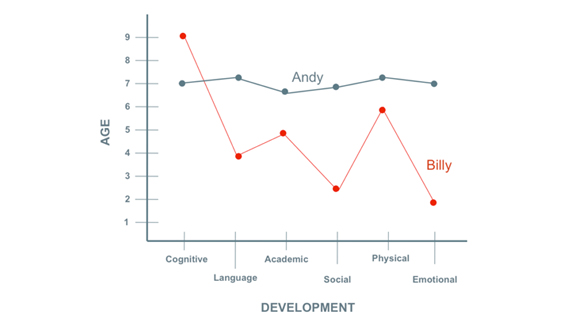
Billy's development has been severely impacted by his life experiences. Here's a graph showing the difference between Andy's developmental path and Billy's developmental failures:

Andy and Billy Graph
Here are six areas of development to consider for your child:
  1. Cognitive Development: Children who are limited in their cognitive ability will struggle the most to overcome trauma and will show patterns of quick regression. Other children become advanced in their cognitive thinking and are like the child in this question, labeled "more gifted than the gifted kids." These children will typically be difficult in their behaviors and act out with more intensity.

  2. Language Development: Due to the lack of safe and nurturing one-on-one care, a child's language development is hampered. This is especially true for children adopted internationally whose first language was not English. Language deficits impede understanding (thus it can feel like they aren't listening to you). Acting out becomes a form of expressive communication, as there are no words to simply say, "I'm mad!" or "I'm scared."

  3. Academic Development: Trauma impacts a child's attention span, ability to concentrate, and to organize. This makes it difficult even for a bright child like Billy to succeed in school. He can't keep track of his homework, his backpack is completely disorganized, and he has a difficult time sitting still in class and paying attention. The stress of academics can easily set a child back into feeling helpless (as when they were in the midst of their trauma), so instead of taking on the challenge of school, they simply give up and shut down. (For more information on helping your child in the school environment, click here.)

  4. Social Development: Social interactions have proven to be unsafe and dangerous to many children, so their ability to interact appropriately with peers can be severely compromised. They have lived in "survival" which leaves no room for considering the feelings of others. They need to be taught how to handle the stress of peer relations and may need an adult near them during social play (See Beyond Consequences, Logic, and Control, Volume 2 for more direct ways to help children find safety in social interactions).

  5. Physical Development: Deprivation of not only food but of nurturing and sensitive caretaking often compromises a child's physical development. This is especially true for a child who was diagnosed as "Failure to Thrive."

  6. Emotional Development: While a child like Billy has a birth certificate that says he is seven, he will likely be extremely emotionally immature. He needs to experience safe and nurturing emotional interactions in order to rebuild his foundation. He needs emotionally sensitive caretaking to get back on track and regain the experiences his friend, Andy, has been given all along.
Billy is all over the graph in his developmental path. Where is your child? Take the time to consider each of these areas for your child. If your child is more like a three year old emotionally, he needs to be met at this age in order to move forward in his development. Asking a child to respond with the emotional flexibility of a seven year old when he is only three years old in his development will prove to be maddening as a parent and more importantly, is unfair to the child.
Children need to be accepted for who they are and for what their life experiences have created within them. Unconditional love requires us to get out of our own fears of "babying" our child in order to meet our child exactly at his developmental age. Be honest with yourself and objectively determine the actual capabilities of your child.
When you are able to meet your child at his/her level of development, you are opening up the door to healing. Your child will feel more accepted, understood, and validated. This allows love to flow and for the parent/child relationship to be rebuilt. It is in the context of your loving relationship with your child that the graph of Billy can soon look closer to that of Andy. Children are resilient and are neurologically flexible. Healing, and thus behavioral change, takes a willingness to see a child for exactly who he is and to stop expecting him to be like the example of Andy, especially if the child has a traumatic history.
For more information and an in-depth look at developmental trauma, click HERE to access my latest DVD series at a special internet price.

Press on,


Heather T. Forbes, LCSW
Parent and Author of Beyond Consequences, Logic & Control: Volume 1 & Volume 2,
Dare to Love
, and Help for Billy.

Tuesday, January 27, 2015

Does your child hate school? Let's make this different together.

Starts Tonight!
Join Heather T. Forbes, LCSW, live TONIGHT for her ONLINE "Beyond Consequences Classroom" course. Come as a guest to this first class. That's right, there is no charge to be a full participant in this beginning session! Click here to find out more.


5 Weeks of LIVE Support
Tuesdays: January 27 - February 24, 2015
Each of the 90 minute classes with meet at the following times on Tuesdays and you'll have a chance to ask YOUR questions each session:
Times:
                    9:00 p.m. Eastern
                    8:00 p.m. Central
                    7:00 p.m. Mountain
                    6:00 p.m. Pacific
Each Class is Recorded.
After each session, you will receive a link to download the MP3 recording of the live session. So if the times above are not convenient, you will never have to miss a session completely. Just download the recording and you will have all the information to listen to at your convenience. This also means you can build your library of resources and add each session to be able to have in the future.

This course will focus on the following school issues:
  • How to Smooth School-Related Transitions

  • How to Reduce Homework Battles

  • What Yelling Does to a Child's Nervous System

  • How to Create an IEP That Helps a Child Regulate

  • What it Takes to Build the Parent/Teacher Relationship

  • What Being Flexible Means Rather Than Being Rigid

  • How to Awaken a Child's Internal Sense of Motivation

  • Why Reactive Responses Create More Negativity

  • How to Break the Negative Cycle in the Classroom

  • How to Support Teachers Effectively

  • How to Make the Playground a Positive Experience

  • What is Driving a Child's Negative Behaviors

  • How to Create the Beyond Consequences Classroom

  • Why to Replace Time-Outs with Time-Ins

  • Why External Controls Are Ineffective

  • How to Engage a Resistant Child in Relationship

  • Why Emotional Safety Increases Academic Success

  • How to Close the Gap in Social Skills Deficits

  • What Awakens a Child's Internal Control System

  • How to Create Emotional Safety in the Classroom

  • How Teachers Can De-Escalate Behaviors Immediately

  • How to Effectively Replace Punishment with the Relationship


Heather's most recent book, Help for Billy will be the guide for this course and will bring this book to life. 


Register and Receive "Two-For-One"
If you decide to register for the entire class, the registration fee includes two people for the price of one. You and another support person (teacher, principal, guidance counselor, aide, husband, wife, partner, co-parent) will receive all five instructional sessions of LIVE interactive webinar training! This means if you are in two separate locations, you each will be able to log into all the sessions from different computers. This gives your child the abilitiy to have the people in his/her life working from the same framework to ensure the very best academic year. Click here to register for the entire 5-week class.


Take Action the Second Half of this School Year
Don't just "hope for the best" this second half of the school year for your child. There is a huge lack of understanding in how our children think, how they interprete the world, and how easily they collapse in the face of fear in the school environment. Take active measures to make this second half of the year successful.

Click HERE to sign up for tonight's complimentary first session.

Tuesday, January 20, 2015

When the File Cabinet Drawer Won't Open


Q: My daughter, Gina, is 15 years old (adopted at 2 ½ with the first years of her life being very traumatic). She gets so frustrated with herself when she can't remember the instructions her soccer coach gives her (and her coach gets very frustrated with her as well). When Gina gets stressed out, she simply cannot process the information or store the information in her brain properly. I think if my daughter were to understand herself better, she could cope better during moments of stress. Would you be willing to write a letter to her directly that would explain what is going on because I know she could listen to it from you, instead of me (her mom!). Thank you.
Dear Gina:
Early childhood experiences (when you're a baby and/or toddler) of trauma can affect you much later on in life (like when you're 15 years old or older) in many different areas. One of the most prominent areas is in your ability to handle stressful situations. When you face stress from teachers, coaches, your parent(s), and other adults who have expectations of you, it can be as if your brain turns into a cobweb. The ability to process and store new information is reduced and hindered.

Here are few facts to remember to help you understand yourself:

  1. When you are stressed out, your brain cannot store new information.
  2. Your brain's ability to process information (old or new) is compromised (limited) when you're stressed.
  3. Stress causes confused and distorted thinking. You just can't think clearly.
  4. It becomes very difficult to recall information you learned recently. It is as if you're standing in front of a file cabinet and there are documents in the file cabinet, but you can't access them because the file cabinet is locked.
  5. When stressed, your brain goes back to old patterns. It is like a plane that is being operated by a pilot (you) when suddenly the "autopilot" switch gets turned on and you have no control. You go into autopilot and every decision is based on old information and old patterns.
  6. Rigid thinking becomes the dominant thinking. You are not able to be flexible. Answers have to be "yes" or "no," there is no "maybe." Things are either "wonderful" or "horrible," there is no "it's just okay." Things have to be done "now" not "later." In other words, there is a great sense of urgency...NOW!
  7. Your brain cannot process language when stressed. Adult instructions are confusing and they sound more like the Charlie Brown teacher. The problem is that most adults don't realize this so they only get frustrated with you and they think you are ignoring them, when you're not.
  8. When stressed out, your body can get overwhelmed and take over in very reactive ways: freezing up, shutting down, hitting others, screaming, yelling, throwing objects, throwing up, getting sick, and more.
To keep this from stopping you from being the best you want to be, there are some things that can be done, but they do take work. Here are some suggestions:
  1. When feeling stressed, work to get yourself regulated. Make a list of what works for you. Some of these might be deep breaths, mantras (like saying to yourself, "I'm okay and I've always been okay."), pictures of your family (anything visual), or a special item like a rock or a charm (something that you can touch). Be creative and make a list to help you remember when you get stressed next time.
  2. When you are starting to get stressed and the person with you is getting frustrated, simply say, "I need a few minutes to process this. Thank you."
  3. Before going to an event that could be stressful (like a soccer game or taking a test), take a few moments to stop and relax beforehand. Walk into the event as calm and regulated as possible to start.
  4. If there is anyway for the person who is helping you or teaching you to draw out the instructions, instead of just verbally telling you, this would be extremely helpful. Your brain can most likely take in visual information better than verbal information.
  5. Ahead of time, let people know you have a, "High Sensitivity to Stress." This simply means you get easily stressed out and you may need a few more breaks to get re-regulated.
  6. Repeat. Repeat. Repeat. Practice. Practice. Practice. It might take your brain longer than some of your friends to retain the information. This does NOT mean you're stupid. This only means your brain needs more time to put things "in the file cabinet" (your brain).
  7. When you do get stressed, be sure to allow yourself to process through all the big feelings once you're in a safe place (like at home with a parent). You have to safely let go of all the stress so it doesn't get locked up in your body. Sometimes just a good cry is what you need and it can be a wonderful release!
  8. Simply being aware of how your brain works along with being mindful can be a big step in changing all of this.
  9. This is the most important tip: You have to love yourself and stop judging yourself as a "bad" person or a "dumb" person or a "worthless" person (or any other negative beliefs you may have going on in your head). This issue of how your brain processes and retains information is not about who you are as a person. You're living a journey of trauma recovery and it is a gift in many ways...it is keeping you intuitive, aware, connected, emotionally intelligent, and much more! Acceptance of who you are is the key.
Press on,


Heather T. Forbes, LCSW
Parent and Author of Beyond Consequences, Logic & Control: Volume 1 & Volume 2,
Dare to Love
, and Help for Billy.

Tuesday, January 6, 2015

Are You Happy?


It's a new year and a good time to start fresh. Let 2015 be a year of happiness for you and your family. Let us help you find happiness this year, no matter the circumstances. 

Join us tonight for a webinar all about happiness. 

When: January 6, 2015 at 6pm MST.
Where: From your computer
Cost: $15 
Register here: